

About me
I am a primary school teacher. I have always seen my work as part of a School that reaches beyond my own classes and the children entrusted to me.
I continue to work and devote my efforts to this School.
For some time, I have been developing a project I chose to call “Not One Less”, after Zhang Yimou’s beautiful 1999 film.
“Not One Less” is an approach I have tried to make my own. It inspires the learning pathways, ideas, strategies, physical tools and software I develop to bring the best mathematics learning opportunities to every child.
This is why I meet so many teachers: to share simple, accessible tools that can support their daily and increasingly demanding efforts to offer every child the best possible opportunities.
And this is why I created this website: so that every educator, in any place or classroom, can use an ordinary internet-connected device to access a wealth of tools and ideas that renew their energy, enthusiasm and commitment to offering the Best School to everyone: not one less.
Every classroom is a mixed-age classroom
Of my many experiences as a primary school teacher, working as a learning support teacher and teaching mixed-age classes played a fundamental role in shaping my approach to teaching and mathematics.
Both as a learning support teacher and later as a class teacher working with children supported by specialist teachers, children with other special educational needs and children with specific learning difficulties, I have always sought to encourage everyone’s participation.
A mixed-age class has often been regarded, and unfortunately still is, as an unusual arrangement: a collection of separate year groups to be taught individually. I remember the advice I was given as a substitute teacher:
“Teach the fourth-year pupils numbers up to ten thousand and give the fifth-year pupils a worksheet; then teach the fifth-year pupils numbers up to one hundred thousand and give the fourth-year pupils a worksheet…”
But why not find a learning pathway that allows everyone to discover together how numbers work? And then offer materials and strategies so that each child can practise and explore further according to their abilities and possibilities?
This question has guided my search for learning pathways for everyone, while maintaining high-quality learning opportunities: support for those who encounter difficulties and new challenges for those who are ready to go further.
I believe that every classroom can be seen as a mixed-age classroom, because every group brings together different learning paces, knowledge, needs and ways of learning. There is something special about every child’s educational needs. Each child deserves attention to the difficulties they encounter and meaningful opportunities to develop their potential.
The commitment
I believe deeply in School as a place where a better future for every child can be sown and nurtured.
Everyone is born with potential and grows up in a physical, social and family environment that can strongly influence their future. All too often, a child’s path seems already determined, for better or, sadly, for worse. Unless they encounter a good School along the way: the Best School, made possible by dedicated educators. A School that nurtures abilities and passions and develops each child’s potential. A School that provides the best tools to help everyone imagine and build the best possible future.
propensity and learning
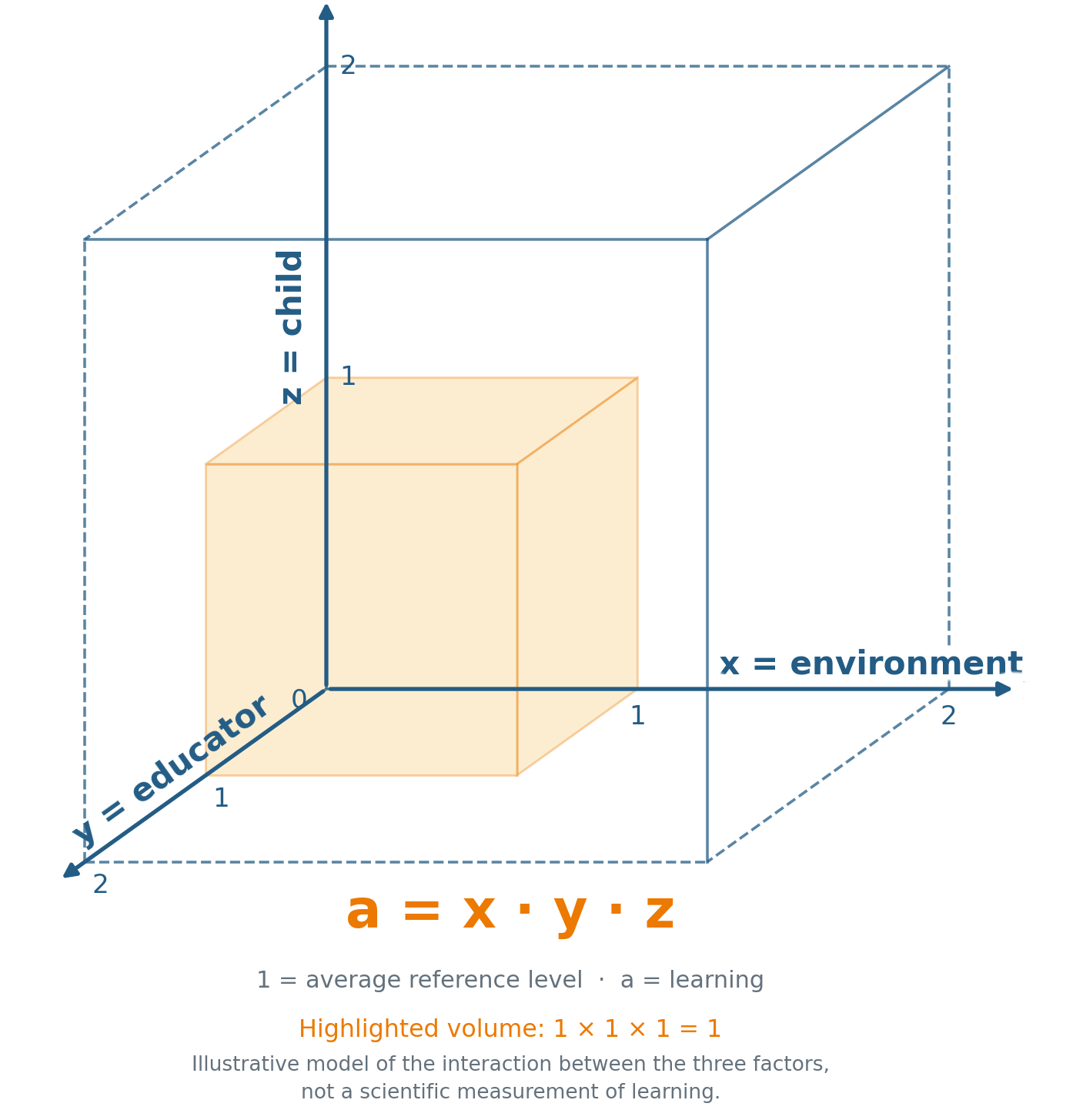
The variables that influence learning are many and complex. Without claiming to measure learning scientifically, but simply as a way to explore an idea, this diagram brings together three of them: the environment (x), the educator’s propensity (y) and the child’s propensity (z). By environment, I mean the family, social, physical and school conditions in which a child grows and learns.
The letter a stands for learning, represented by the volume obtained by multiplying the three factors: a = x × y × z. We conventionally assign the value 1 to an average level of each factor: if all three equal 1, the learning represented also equals 1.
For example, with an unfavourable environment (x = 0.75), a high level of educator propensity (y = 1.5) and an average level of child propensity (z = 1), we obtain a = 1.125: a value above the average reference level. If all three factors equal 0.75, the result falls to approximately 0.42. In this model, therefore, a greater propensity on the educator’s part can support learning even in difficult environmental conditions.
Of these three factors, educators can act directly on themselves: on their attitude, expectations, preparation and teaching choices. They cannot decide on a child’s behalf to be curious or motivated, but they can create experiences that nurture curiosity, confidence and a desire to learn.
The starting point is therefore to work on our own propensity so that we can nurture the child’s, while also improving the aspects of the learning environment that we can influence.
It is in this sense that a good teacher makes a difference.
What is propensity?
Propensity is a natural inclination or tendency towards something. The Italian dictionary Treccani describes it as the quality of someone naturally inclined to do something.
Related words include inclination, disposition, aptitude, preference, affinity, love and passion.
We often describe someone as naturally good, or not so good, at something, implicitly assuming that this is an inherited quality we can do little to change.
Yet our inclinations can be influenced. For example, advertising can change our willingness to buy things. The fact that inclinations can be nurtured may also help explain why children sometimes follow in the footsteps of a parent who has excelled in a particular field.
A child’s propensity can be nurtured and strengthened, but it can also be discouraged or diminished by their experiences. As educators, we can start with what we directly control: ourselves, our attitude and our choices. Working on our own propensity helps us nurture the child’s and create the conditions for everyone to approach mathematics, language and the arts with confidence.
This idea is the starting point for cognitively rich learning pathways: activities that turn educators’ commitment into engaging, inclusive and meaningful mathematical experiences.
